The Human Capacity Lab

Human Capacity Lab

A living collection of products, frameworks, workshops, and systems — each exploring one question.

How do we help people and organizations increase capacity without losing judgment, agency, or humanity?

Technology should reduce cognitive load, not create it. AI should expand human capability, not replace human thinking. Every project below explores a different dimension of human capacity.

Begin the exhibition
01 — Capacity dimension

Cognitive Capacity

How we think shapes every decision we make. These projects reduce cognitive load, improve decision quality, and build systems that help people focus on what matters.

Four projects
ProductACTIVE

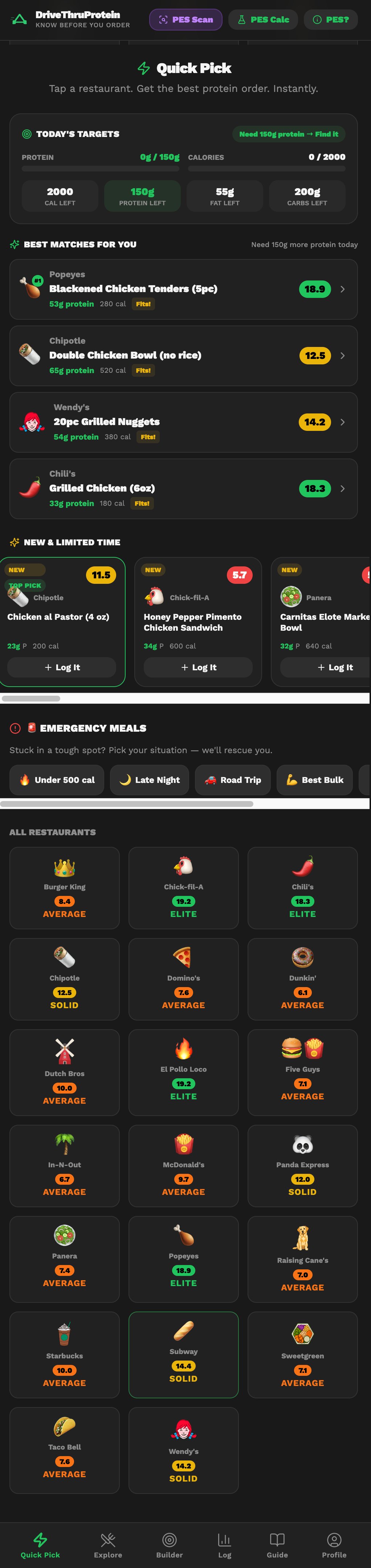
DriveThruProtein

Helping people make healthier decisions in the moments that matter.

Health Capacity
Capacity ThemeHealth Capacity
TypeProduct
StatusActive
Started2025
StageShipped & evolving

The Challenge

Eating well on the go is a data problem disguised as a willpower problem. The information exists, but never where or when you actually order.

The Question

What if the healthiest order at any drive-thru were one tap away, ranked and ready before you reach the speaker?

My Approach

Collapse thousands of menu items into a single Protein Efficiency Score, then design for the two seconds a person has to decide. The tool answers; it doesn't quiz.

What I Built

A mobile-first app that turns nutrition data into an instant, rankable answer.

  • Protein Efficiency Score ranking across major chains
  • Tap-a-restaurant, get-your-order instant flow
  • Structured nutrition data kept current
What I Learned

People rarely need more information. They need a better default in the two seconds before they order.

What's Next

Personalized goals, saved orders, and expanding chain coverage so the answer is right no matter where you pull in.
donehq · command center
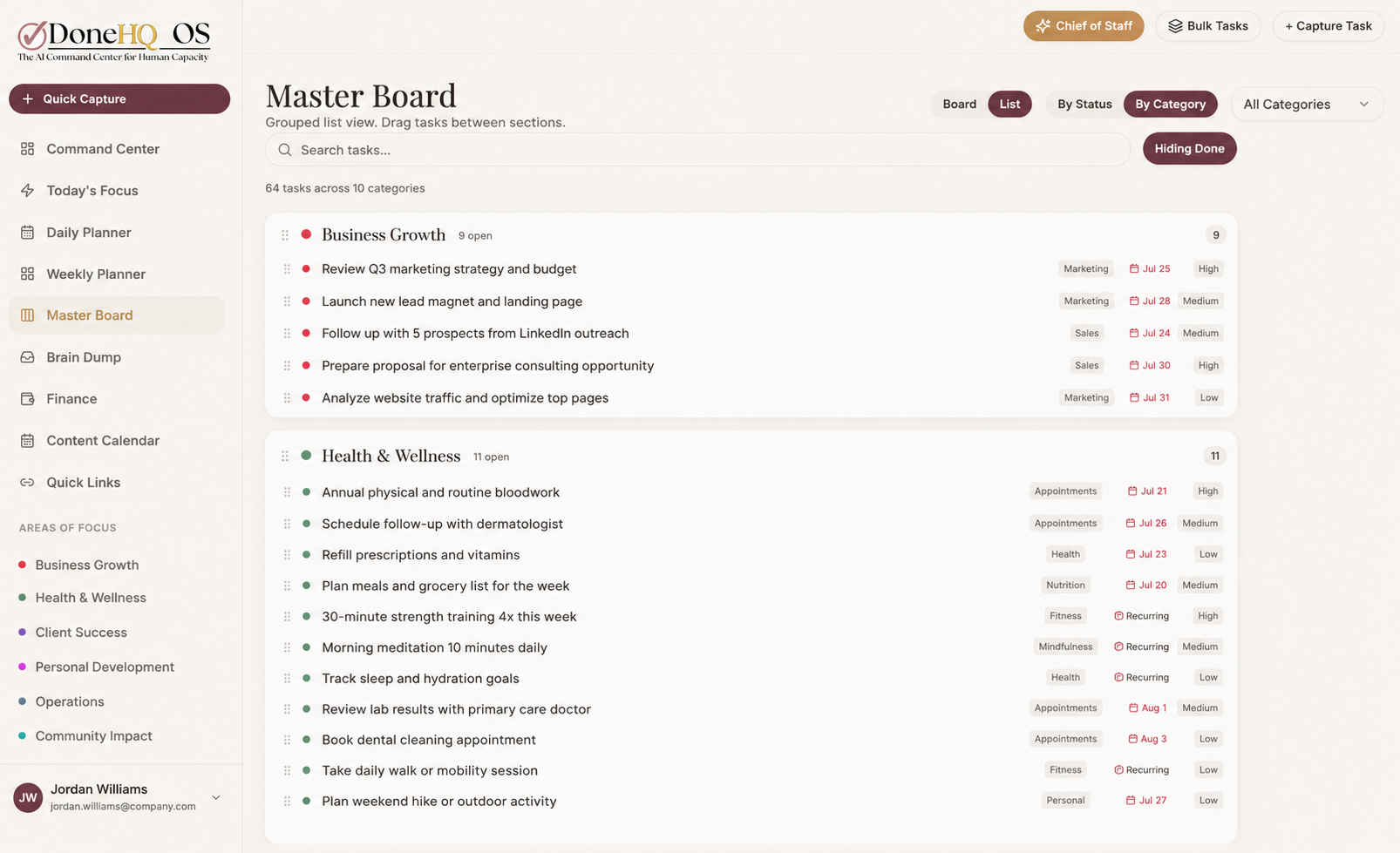
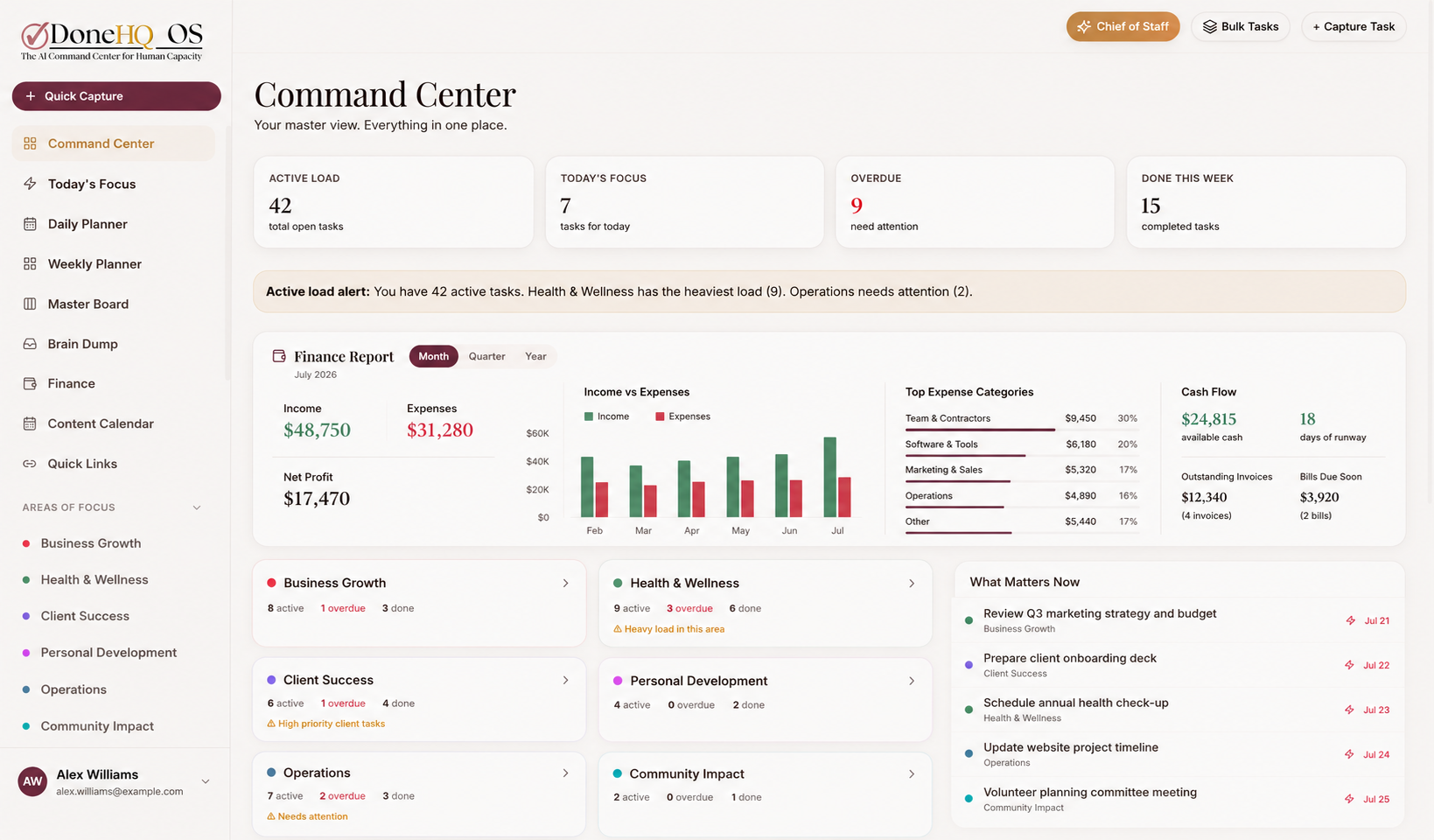
DoneHQ OS Command Center — active load, today’s focus, overdue and completed counts above a monthly finance report and per-area task summaries
ProductIN DEVELOPMENT

DoneHQ_OS

An AI command center for human capacity — one place that answers what matters now.

Decision Capacity
Capacity ThemeDecision Capacity
TypeProduct
StatusIn development
Started2026
StageBuilding

The Challenge

Most productivity tools add a layer of decisions — tags, statuses, projects — before any work gets done.

The Question

What would a task system look like if its job were to protect attention rather than capture it?

My Approach

Design the smallest surface that answers one question — what's the next thing — and let everything else stay out of the way.

What I Built

A working command center, built in Base44, that holds work and life in the same system.

  • Command Center: active load, today's focus, what's overdue, and what actually matters now
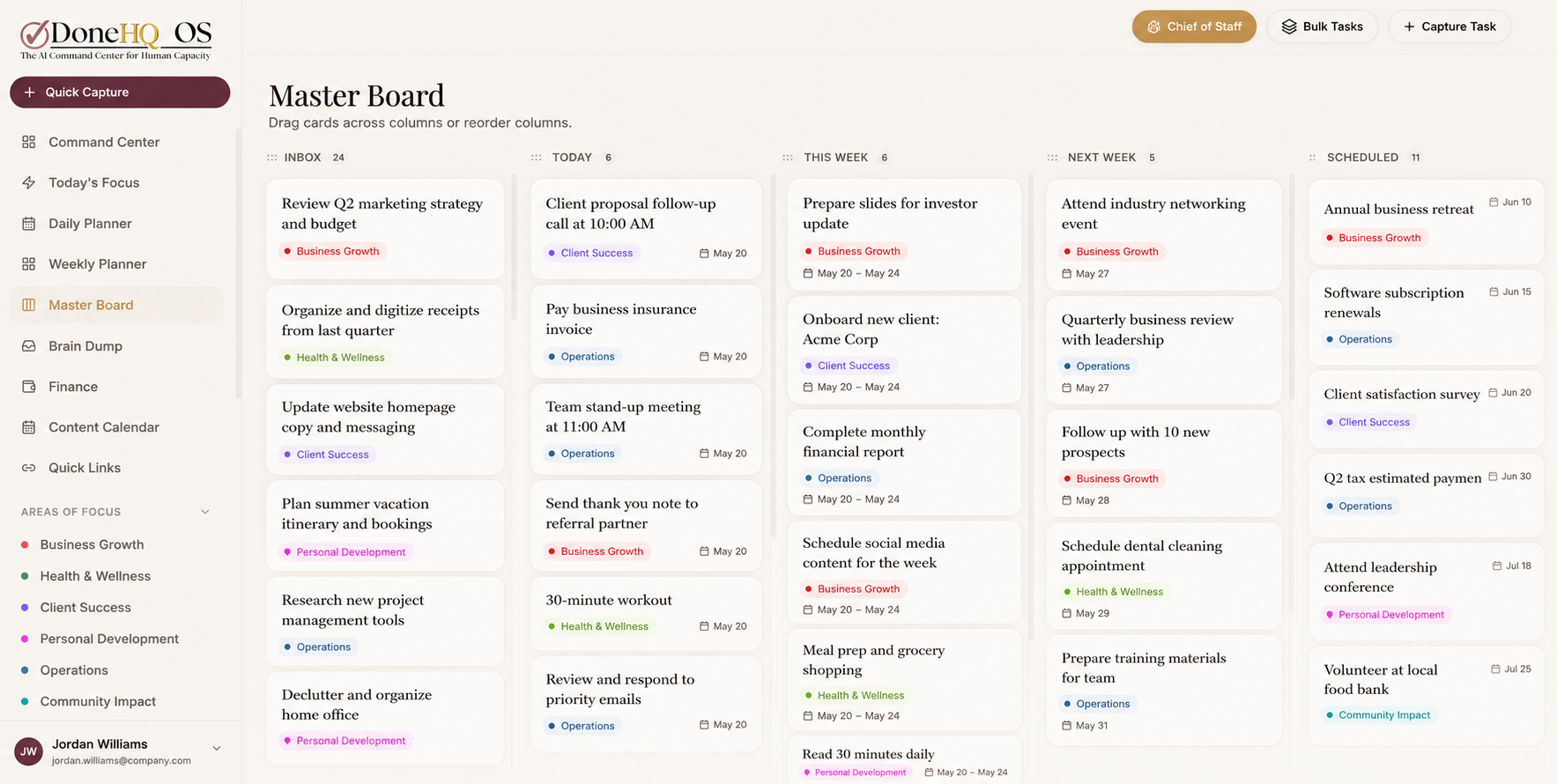
  • A master board that reads as columns or as a grouped list — same tasks, different question
  • Areas of focus instead of projects, so personal and business load are visible together
  • Finance, content calendar, and brain dump in one place rather than four tools
  • A Chief of Staff that reads the load and tells you where it's concentrated
What I Learned

Productivity tools fail when they add a step. The win is removing the decision, not organizing it.

What's Next

A closed pilot with a handful of operators to pressure-test whether less really does more.

my patient hq · home base
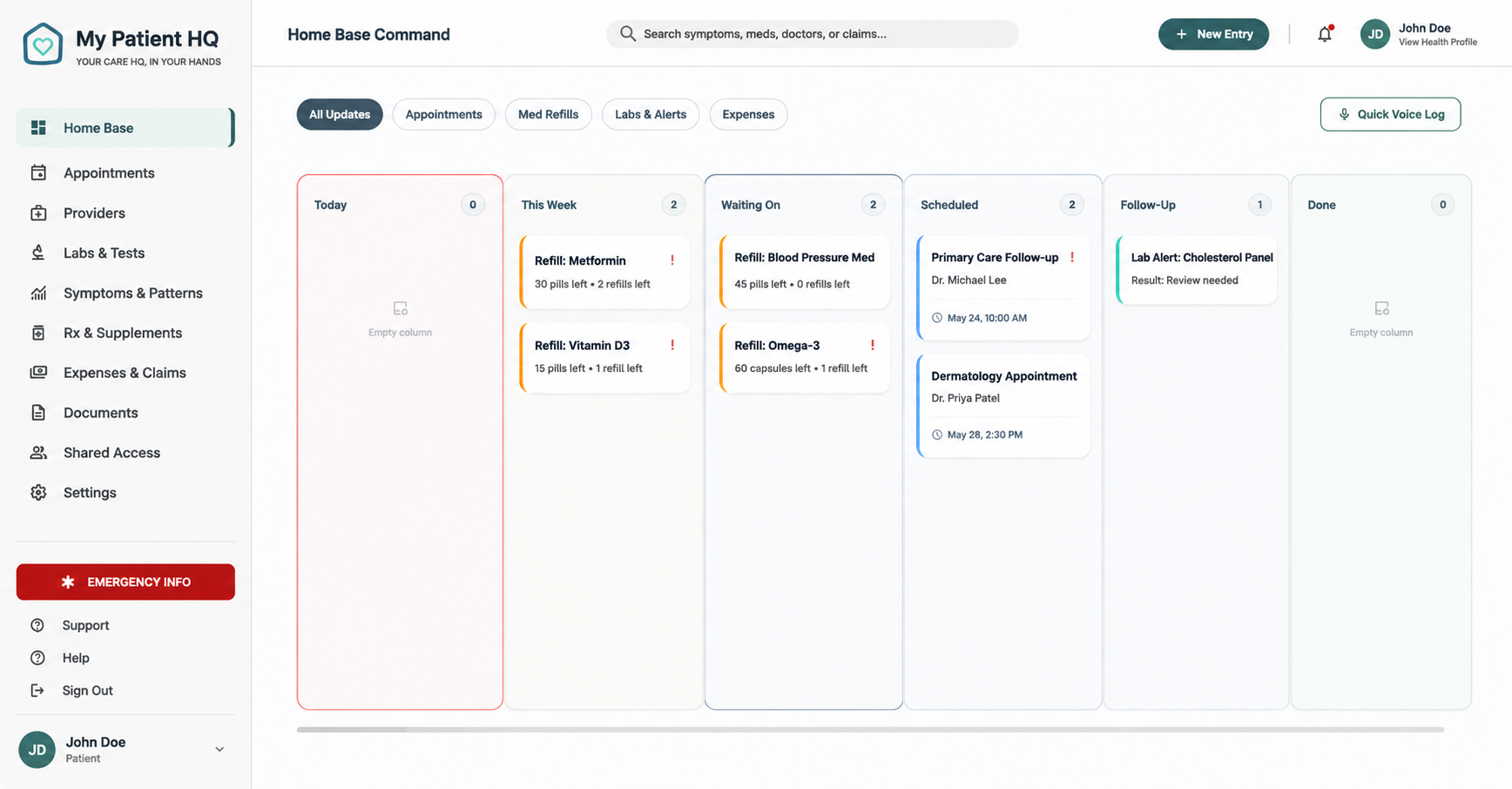
MyPatientHQ Home Base Command — refills, appointments, and lab alerts tracked as cards across Today, This Week, Waiting On, Scheduled, Follow-Up, and Done
ProductIN-PROGRESS

MyPatientHQ

Walk into the appointment with your own data, not just your memory.

Health Capacity
Capacity ThemeHealth Capacity
TypeProduct
StatusIn-Progress
Started2026
StageBuilding

The Challenge

This one comes out of my own experience, and out of the chronic illness community I'm part of. When you live with something ongoing, you are the only person holding the whole picture — across specialists who don't talk to each other, portals that each show a fragment, and appointments where you have fifteen minutes to remember eight months.

The Question

What would it take to walk into a doctor's office with data instead of a vague account of how you've been feeling — without becoming your own medical records clerk to get there?

My Approach

Treat the patient as the command center, not the last one to find out. Make logging fast enough to actually happen on a bad day, then do the work of turning those entries into patterns a person can point at.

What I Built

A working build in progress — prototyped in Google Stitch, now being built in Antigravity.

  • Home Base: refills, appointments, labs, and follow-ups in one view of what's actually pending
  • Symptoms & Patterns — track over time and spot trends before the appointment, not after
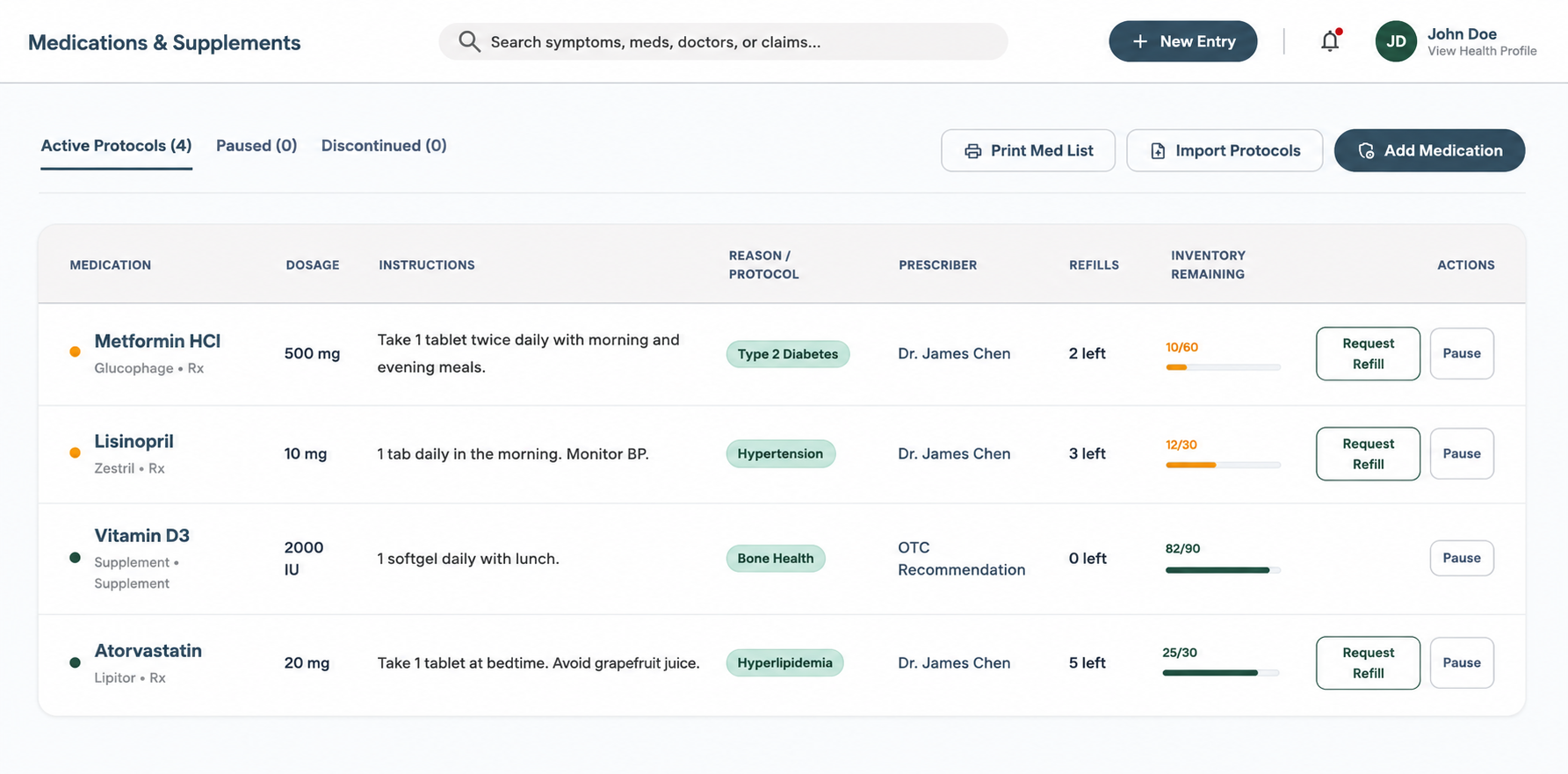
  • Medications and supplements with dosage, prescriber, refills, and inventory remaining
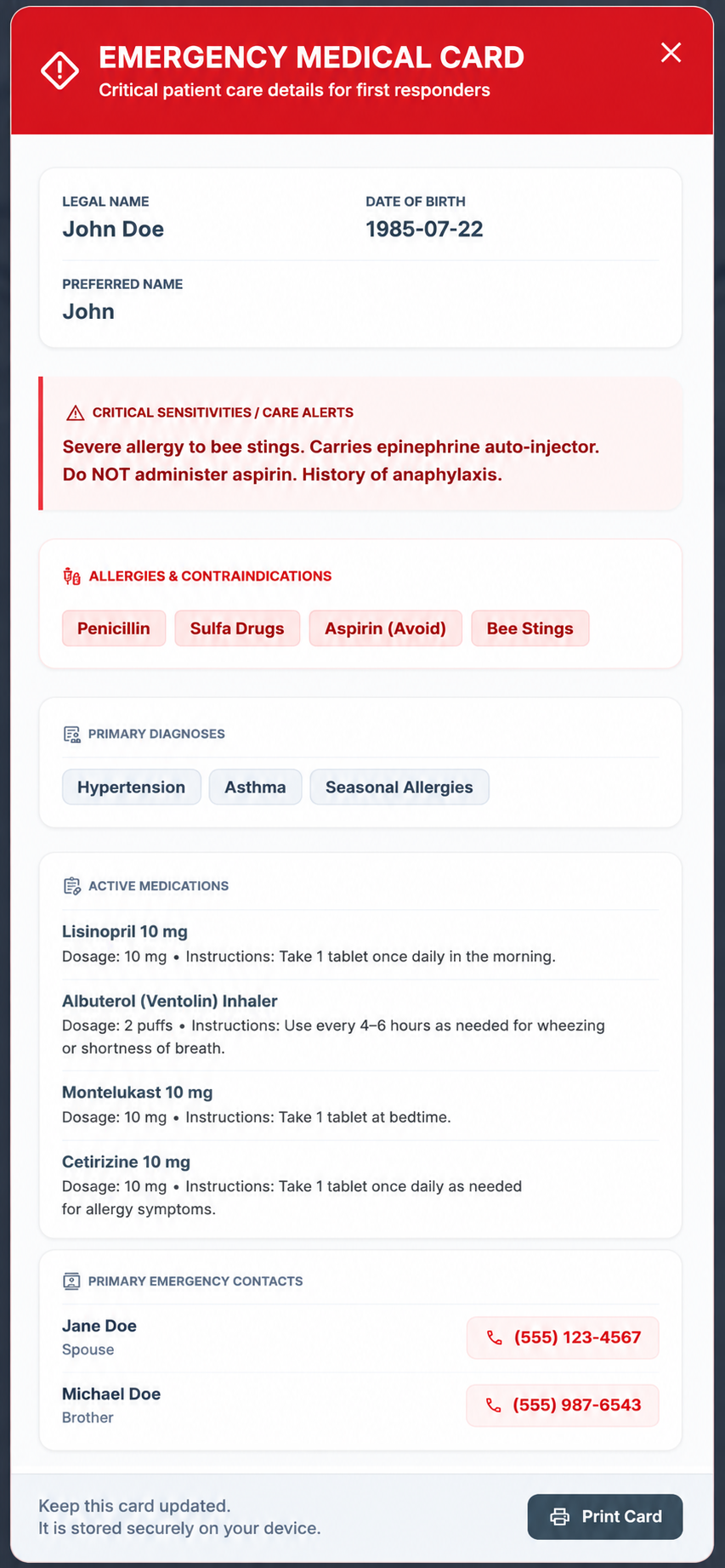
  • An emergency card first responders can read, printable, on your device
  • Shared access, so a spouse or caregiver isn't locked out of the picture
What I Learned

Self-advocacy is a capacity problem. Patients aren't short on will — they're short on retrievable information at the exact moment it matters.

What's Next

Finishing the build, then testing it with people in the chronic illness community — the standard being that it reduces load on a bad day, rather than adding one more portal to check.

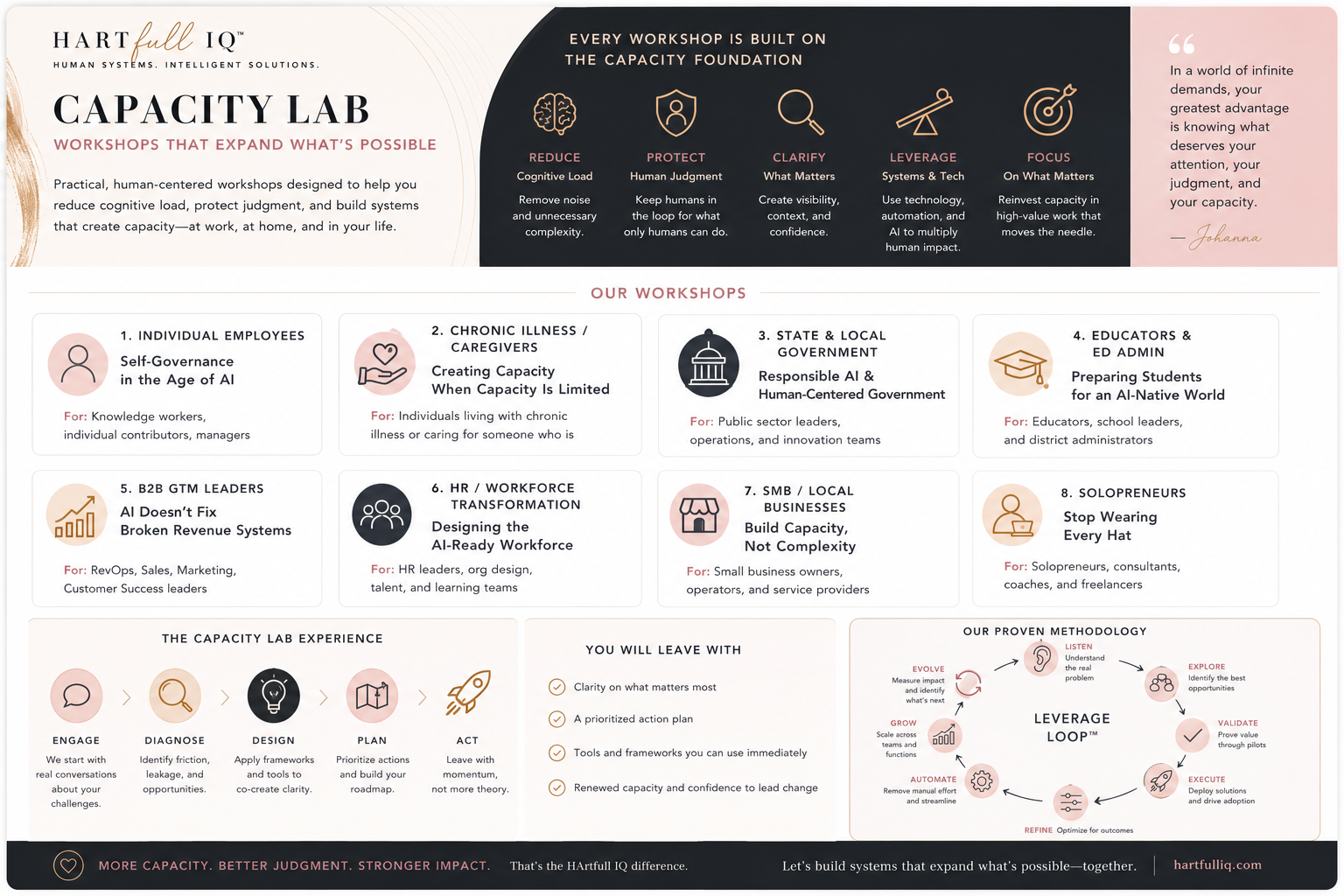
skills.hartfulliq.com
AppACTIVE

AI Skill Assessment

Seeing which parts of your role AI reshapes — and which parts compound your judgment.

Career Capacity
Capacity ThemeCareer Capacity
TypeApp
StatusActive
Started2025
StageShipped

The Challenge

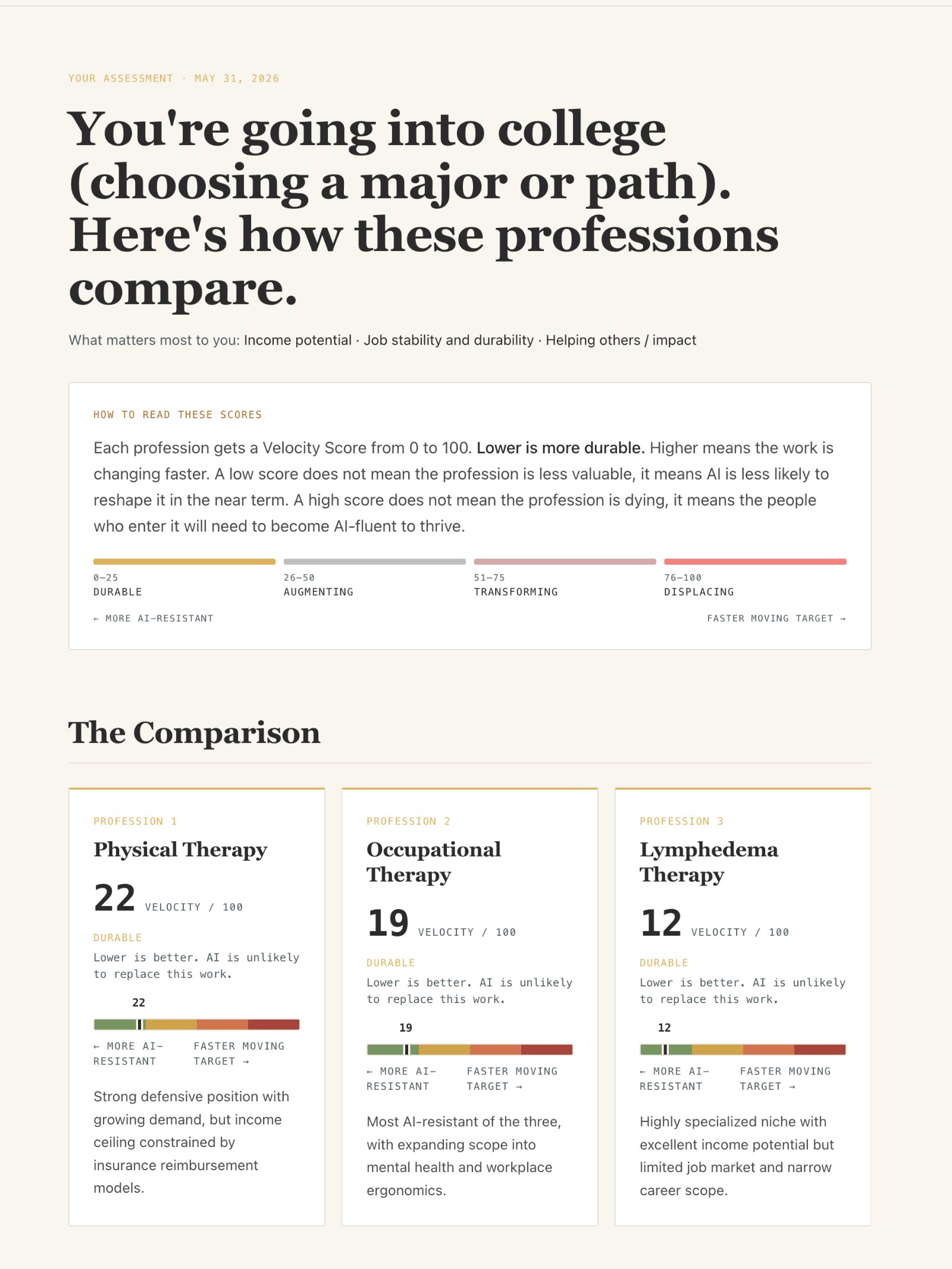
The "will AI take my job" conversation stays abstract, so people either panic or ignore it. Neither helps them decide what to learn next.

The Question

Can we make the impact of AI on a specific role concrete enough to act on this week?

My Approach

Parse a real job description, then map it task by task — what AI reshapes, what compounds human judgment, and where to invest learning time first.

What I Built

A parser that turns a pasted job description into a task-level read.

  • Paste-a-JD parsing into a task-level read
  • Reshaped vs. judgment-compounding split
  • A prioritized learning starting point
What I Learned

AI doesn't replace roles. It redraws the line between the parts of a job that compound judgment and the parts that don't.

What's Next

Team-level rollups so managers can plan reskilling across a whole function, not one role at a time.

02 — Capacity dimension

Organizational Capacity

Before AI can help, a system has to be understood. These frameworks and diagnostics help a team see how it actually works — and where judgment has to stay.

Seven projects
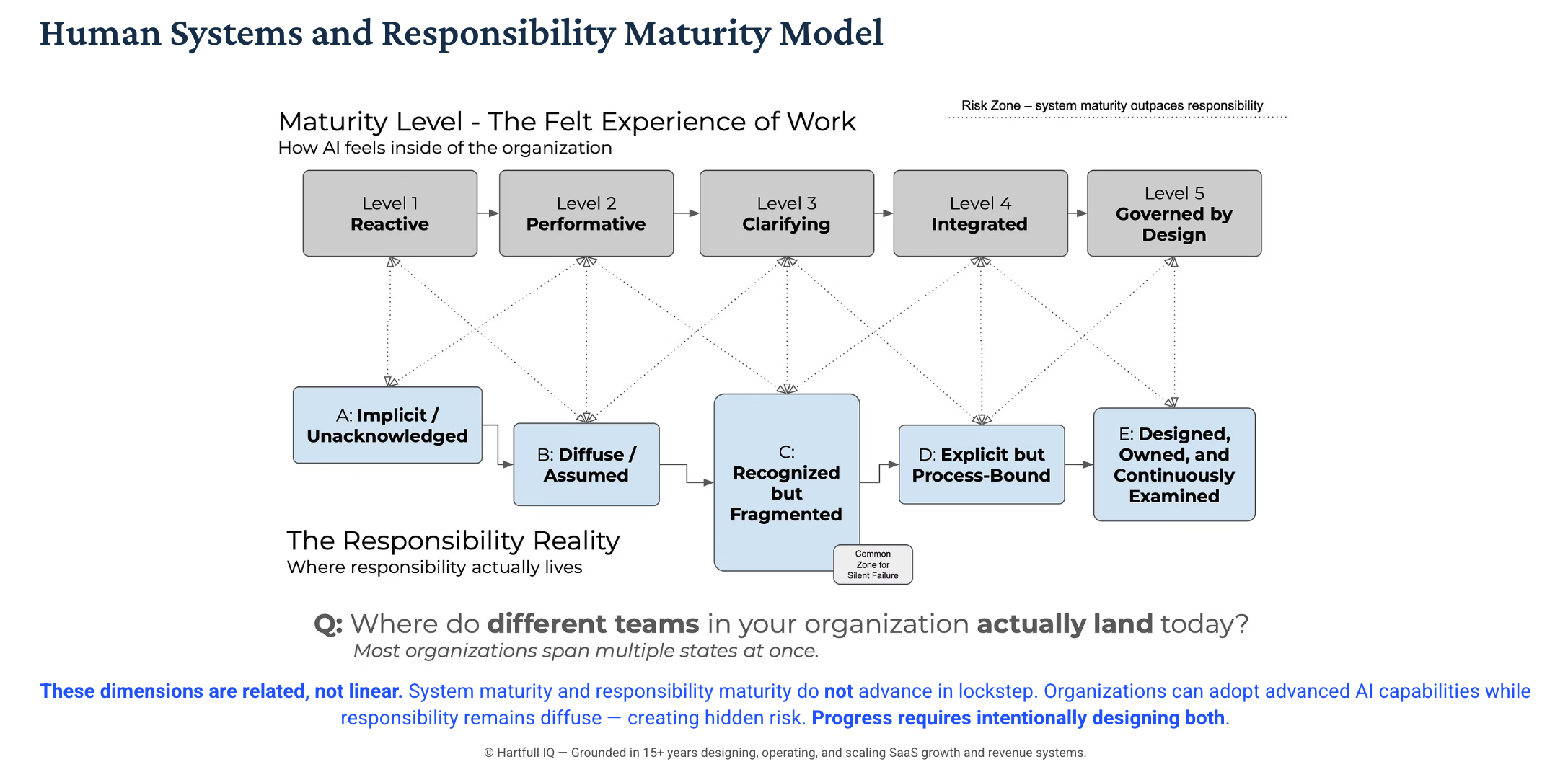
The Human Systems and Responsibility Maturity Model — five maturity levels of felt work experience (Reactive, Performative, Clarifying, Integrated, Governed by Design) plotted against five states of where responsibility actually lives (Implicit, Diffuse, Recognized but Fragmented, Explicit but Process-Bound, Designed and Continuously Examined), with a risk zone where system maturity outpaces responsibility
Framework · ResearchEVOLVING

Human Systems Maturity Model

A map of how ready an organization's systems really are before AI touches them.

Organizational Capacity
Capacity ThemeOrganizational Capacity
TypeFramework · Research
StatusEvolving
Started2025
StageRefining through engagements

The Challenge

Companies buy AI expecting a lift, then discover the process it was meant to accelerate was never documented in the first place.

The Question

What has to be true about a human system before automation makes it better rather than faster-broken?

My Approach

Separate two things every maturity model collapses into one: how advanced the system is, and where responsibility actually lives. Plot them against each other and the hidden risk becomes visible — an organization can run sophisticated AI while nobody owns the outcome.

What I Built

A two-axis model a leadership team can locate itself on honestly — including the uncomfortable answer that different teams land in different places.

  • Five maturity levels described by how work feels inside the organization, not by tooling
  • Five states of responsibility, from implicit and unacknowledged to designed and continuously examined
  • A named risk zone where system maturity outpaces responsibility
  • A common zone for silent failure — recognized but fragmented ownership
What I Learned

AI exposes broken systems before it improves them.

What's Next

Pairing the model with a self-serve read, so a team can place itself on both axes without waiting for a workshop.

The LEVERAGE Loop — a continuous transformation loop of eight steps: Listen, Explore, Validate, Execute, Refine, Automate, Grow, Evolve, centered on continuous alignment and sustainable impact
MethodologyACTIVE

LEVERAGE Loop™ Methodology

Finding the one input that moves everything downstream.

Organizational Capacity
Capacity ThemeOrganizational Capacity
TypeMethodology
StatusActive
Started2025
StageIn use with clients

The Challenge

Teams respond to pressure by doing more of everything, spreading effort thin across inputs that don't actually move the outcome.

The Question

Where is the single point of leverage that changes the whole system when you move it?

My Approach

A structured way to trace outcomes back to their upstream inputs, then concentrate effort on the few that compound.

What I Built

A working method for use in a room with a team.

  • A worksheet that maps inputs to outcomes
  • A method for ranking leverage, not urgency
  • Facilitation notes for using it live
What I Learned

Leverage isn't doing more. It's finding the one input that moves everything downstream.

What's Next

Turning the framework into a guided diagnostic so teams can run it without a facilitator in the room.

assessment.hartfulliq.com
App · DiagnosticACTIVE

AI Growth Gap Assessment

Showing owners where AI already creates leverage — and where it's about to break things.

Organizational Capacity
Capacity ThemeOrganizational Capacity
TypeApp · Diagnostic
StatusActive
Started2025
StageShipped

The Challenge

Small business owners are told to "use AI" without any sense of where it helps and where it quietly creates risk.

The Question

What are the few things this specific business should do first — and what should it not touch yet?

My Approach

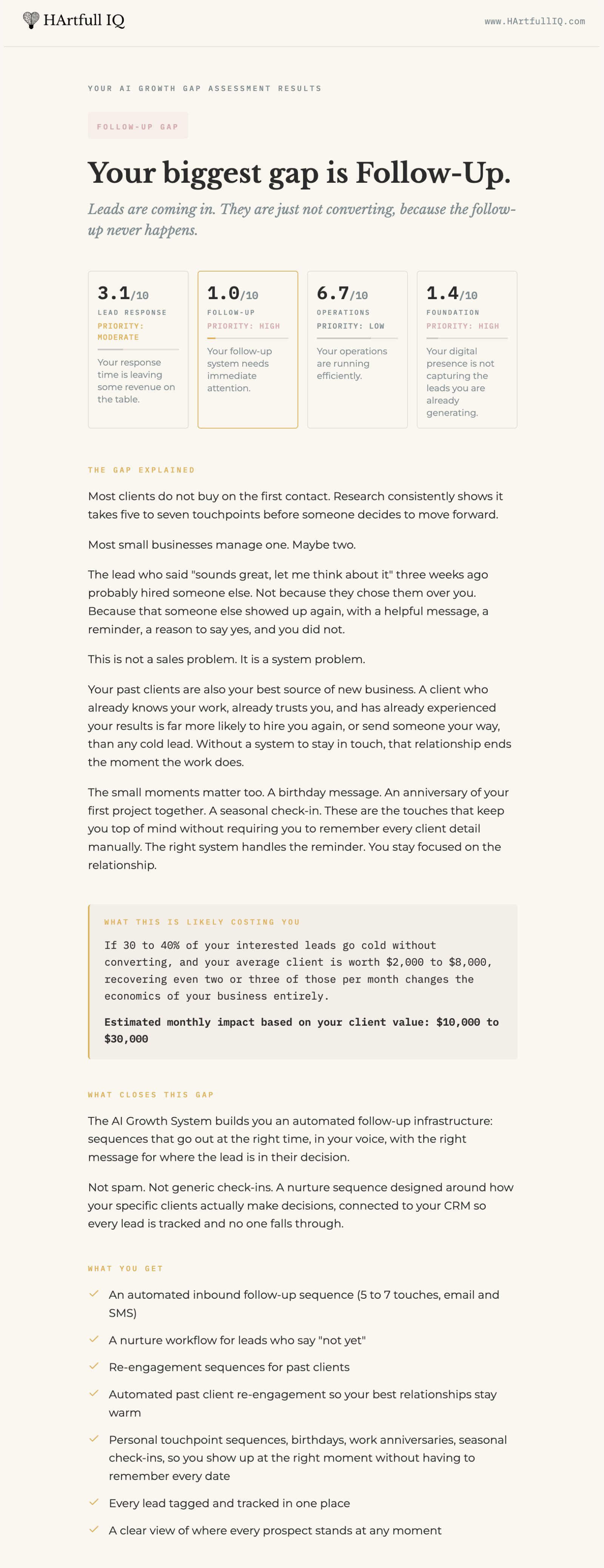
A 14-question read that returns a prioritized list, not another framework to interpret.

What I Built

A short diagnostic with opinionated, plain-language output.

  • 14-question branching logic
  • Prioritized, plain-language output
  • Leverage points and risk flags side by side
What I Learned

Owners don't need another framework. They need to know what to fix first.

What's Next

Deeper integration with Samantha so the whole read can happen in conversation.

revenue.hartfulliq.com
App · DiagnosticACTIVE

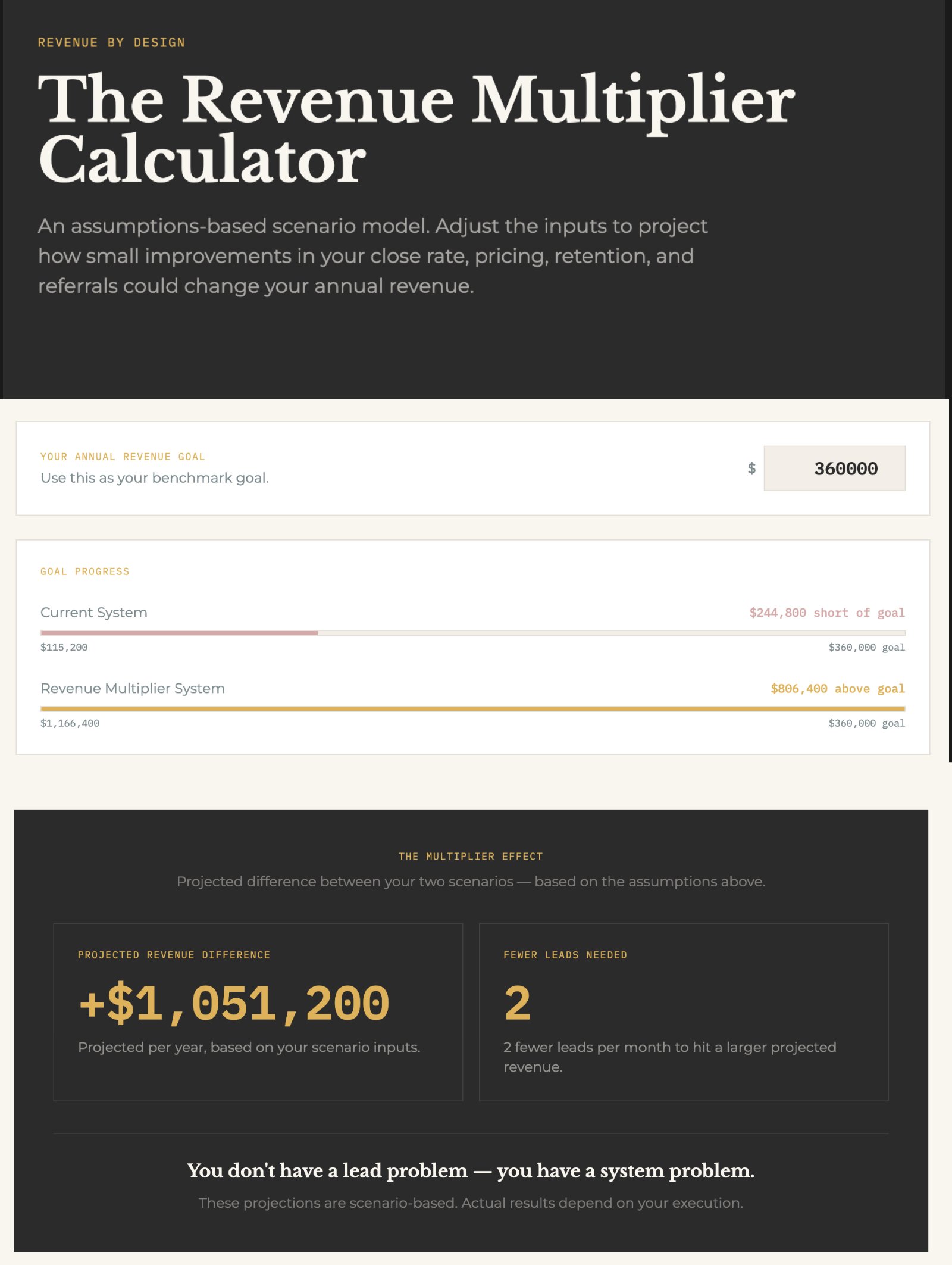
Revenue Multiplier

Turning today's numbers into a concrete picture of the revenue left on the table.

Organizational Capacity
Capacity ThemeOrganizational Capacity
TypeApp · Diagnostic
StatusActive
Started2025
StageShipped

The Challenge

Growth conversations stall on vague ambition. Nobody can see the gap between where revenue is and where it could be.

The Question

What does the multiplier actually look like when you put honest numbers into it?

My Approach

A guided walk-through, run together on a call so the inputs stay honest and the picture is real.

What I Built

A calculator designed to be run live, not left as homework.

  • Step-by-step input flow
  • A concrete revenue-gap picture
  • Built to be run on a call
What I Learned

The revenue is rarely where people are looking. It's in the inputs they stopped questioning.

What's Next

Scenario saving so teams can revisit the model after they act on it.

Also in this dimension
ai-readiness-scorecard.hartfulliq
Capacity ThemeOrganizational Capacity
TypeApp · Diagnostic
StatusActive
Started2025
StageShipped

The Challenge

Readiness scores tend to flatter. They tell teams they're ready right up until the first hard week.

The Question

Which dimensions actually predict whether an AI change survives contact with real work?

My Approach

Assess the factors that hold up under pressure, and turn answers into a picture a team can act on.

What I Learned

Readiness isn't a score. It's whether the change survives the first hard week.

What's Next

Benchmarking so teams can see their read against peers.

revenue-spark-diagnostic.app
Capacity ThemeOrganizational Capacity
TypeApp · Diagnostic
StatusActive
Started2025
StageShipped

The Challenge

Revenue leaders feel the number slipping but can't point to where. Everything looks fine one layer up.

The Question

Which of the five systems — pipeline, signal, motion, architecture, capacity — is actually leaking?

My Approach

A five-category self-assessment that names the category, because naming it is half the fix.

What I Learned

You can't fix a leak you can't see. Naming the category is half the work.

What's Next

Linking each category to a concrete first move.

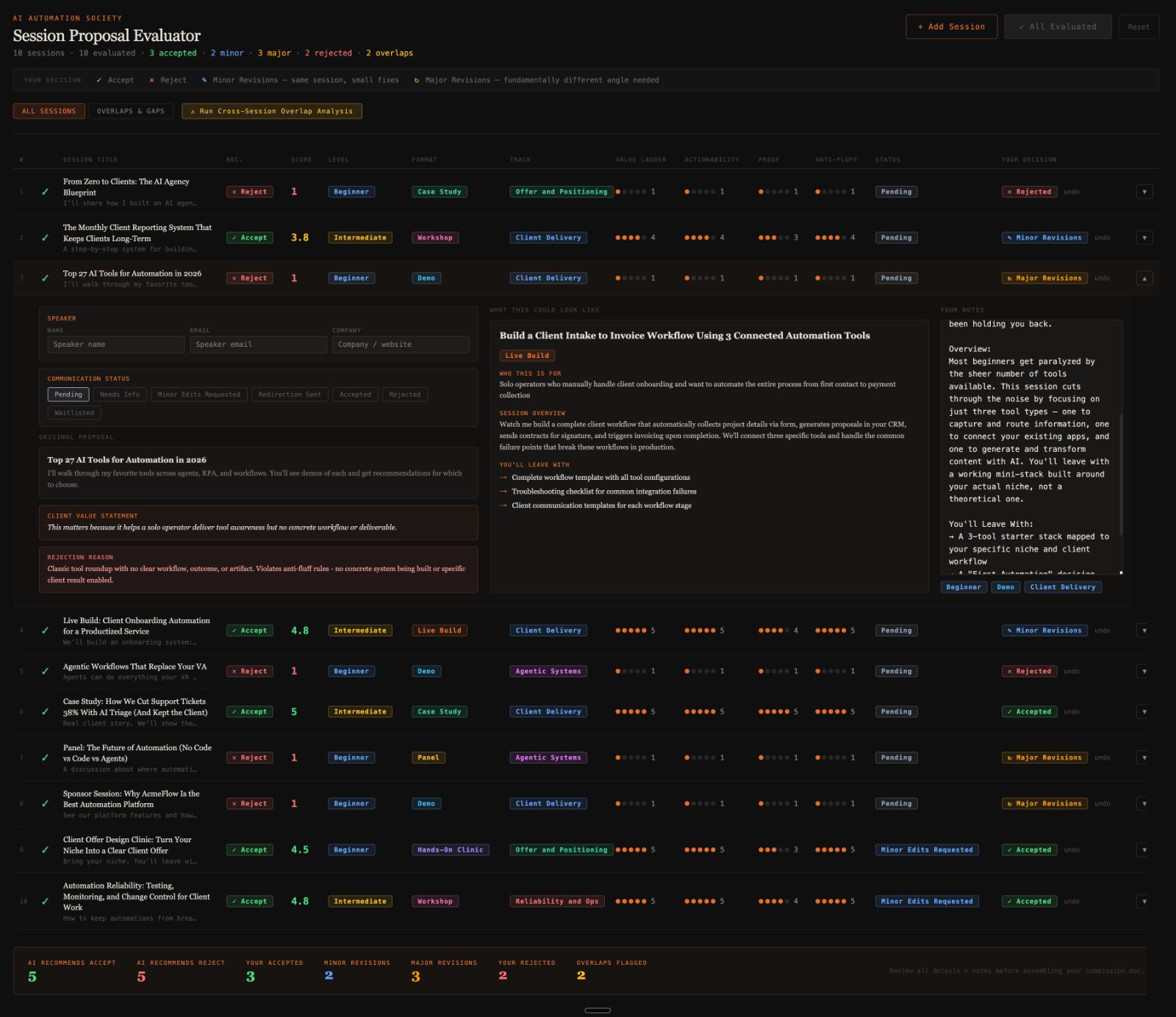
sessionevaluator.netlify.app
Capacity ThemeTeam Capacity
TypeSystem
StatusActive
Started2025
StageIn production

The Challenge

Reviewing a flood of session submissions by hand is slow, inconsistent, and quietly exhausting for a small program team.

The Question

How do you speed the review without handing the final call to a machine?

My Approach

Let AI score against criteria, recommend, and draft a stronger version — then route everything through human approval.

What I Built

A review system built for AI Automation Society+.

  • Scoring against your own criteria
  • Approve/reject recommendations with rewrites
  • Sorting by level, format, and overlap flags
What I Learned

AI should draft and sort. A human should still decide what gets a stage.

What's Next

A reusable version other communities can point at their own criteria.

03 — Capacity dimension

AI Capacity

The most human use of AI expands what one person can do. These agents, systems, and workshops keep judgment in command while removing the friction around it.

Six projects
Workshop photograph — drag an image here, or click Add photo
WorkshopACTIVE

AI Workshops

Building AI judgment, not just AI skills.

AI Capacity
Capacity ThemeAI Capacity
TypeWorkshop
StatusActive
Started2025
StageRunning

The Challenge

Tool training fades in a week because it teaches buttons, not judgment. Teams learn to prompt but not to decide.

The Question

What would it take for a team to leave a session actually changing how they work?

My Approach

Run live, hands-on sessions on the team's real work, so people practice deciding when to trust AI and when not to.

What I Built

A workshop format built around real work and real judgment.

  • Hands-on sessions on the team's own work
  • A judgment framework participants keep
  • Human-in-Command practice, not tool demos
What I Learned

Skills fade in a week. Judgment is what people keep.

What's Next

A recurring cohort so the practice compounds instead of resetting.

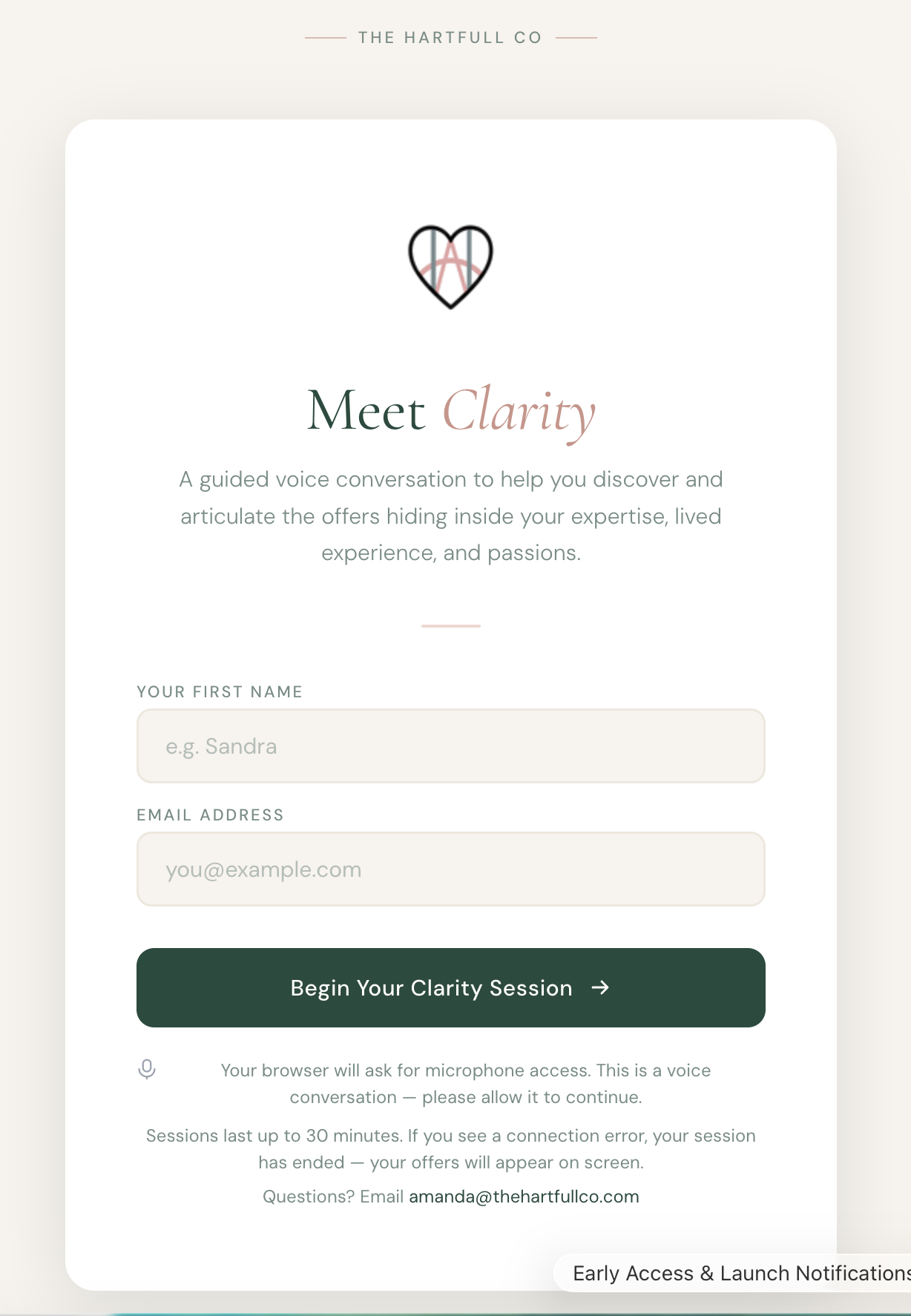
clarityofferagent.netlify.app
Voice AgentACTIVE

Clarity — offer agent

Helping you hear yourself say the offer that was already there.

AI Capacity
Capacity ThemeAI Capacity
TypeVoice Agent
StatusActive
Started2025
StageShipped

The Challenge

People sit on valuable offers because articulating them on a blank form feels impossible.

The Question

What if you could talk it through out loud instead of writing it down cold?

My Approach

A guided voice conversation — up to thirty minutes — that draws out the offers hiding in expertise, experience, and passion.

What I Built

A conversation, not a form.

  • Natural voice conversation, no form
  • Structured prompts that surface offers
  • A clear articulation to take away
What I Learned

The offer is usually already there. People just need to hear themselves say it out loud.

What's Next

A written summary delivered right after the call.

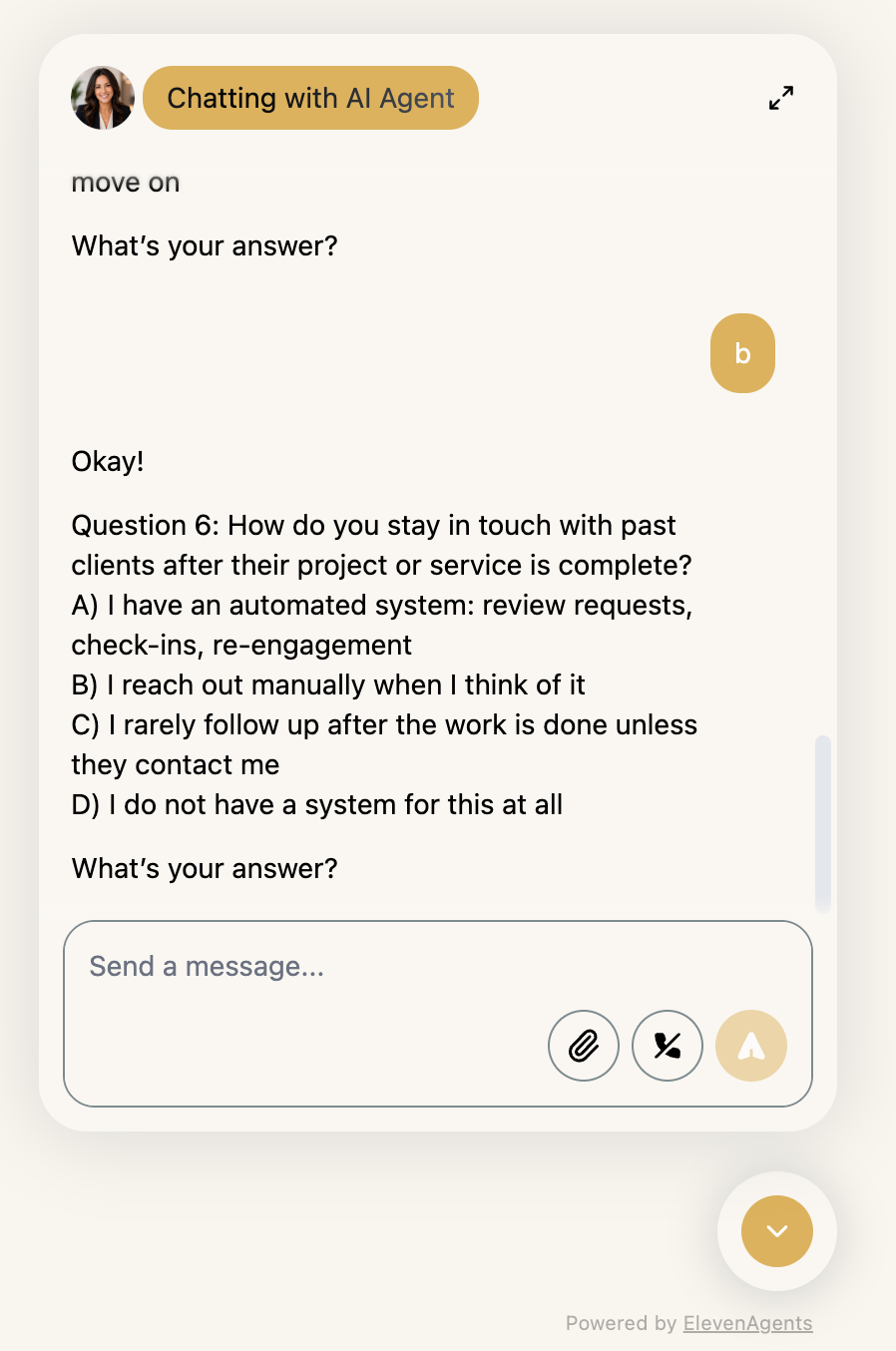
assessment.hartfulliq.com
Conversational AgentACTIVE

Samantha — Gap Assessment agent

Walking owners through the Growth Gap by talking, not filling out a form.

AI Capacity
Capacity ThemeAI Capacity
TypeConversational Agent
StatusActive
Started2025
StageShipped

The Challenge

A good diagnostic still loses people when it looks like a long form.

The Question

Can a conversation pull more honest answers than a set of fields ever will?

My Approach

Wrap the Growth Gap logic in a conversational agent that talks through each answer, then hands back the prioritized read.

What I Built

A conversational front end to the assessment.

  • Talks through answers, no form fatigue
  • Delivers the same prioritized output
  • Built for small business owners
What I Learned

A conversation surfaces honest answers a form never will.

What's Next

A standalone entry point for Samantha, separate from the form-based assessment.

Also in this dimension
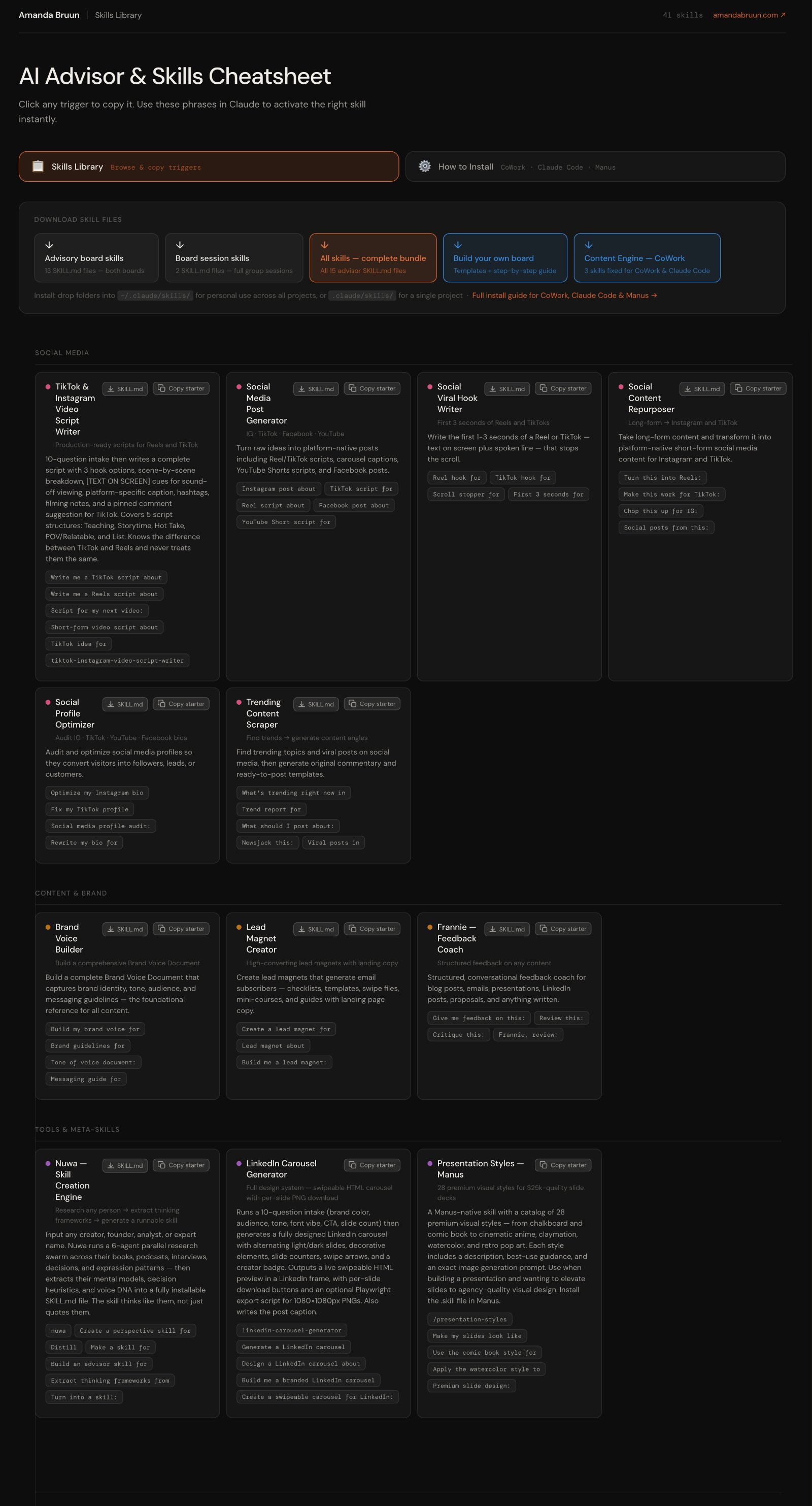
skills-cheatsheet.netlify.app
Capacity ThemeAI Capacity
TypePrompt System
StatusActive
Started2025
StageGrowing

The Challenge

A skills system only pays off if you can find the right one in the moment you need it.

The Question

How do you make 40-plus skills feel like one click, not a folder to dig through?

My Approach

A searchable, filterable reference where any trigger phrase copies with a click and fires the skill instantly.

What I Learned

A system you can't find isn't a system. Findability is the feature.

What's Next

Sharing curated skill packs others can adopt wholesale.

terminal-cheat-sheet.netlify.app
Capacity ThemeAI Capacity
TypeReference
StatusActive
Started2025
StageShipped

The Challenge

The command line is where AI-assisted building actually happens, but the learning curve turns people away.

The Question

What's the fastest way to make an unfamiliar tool feel usable?

My Approach

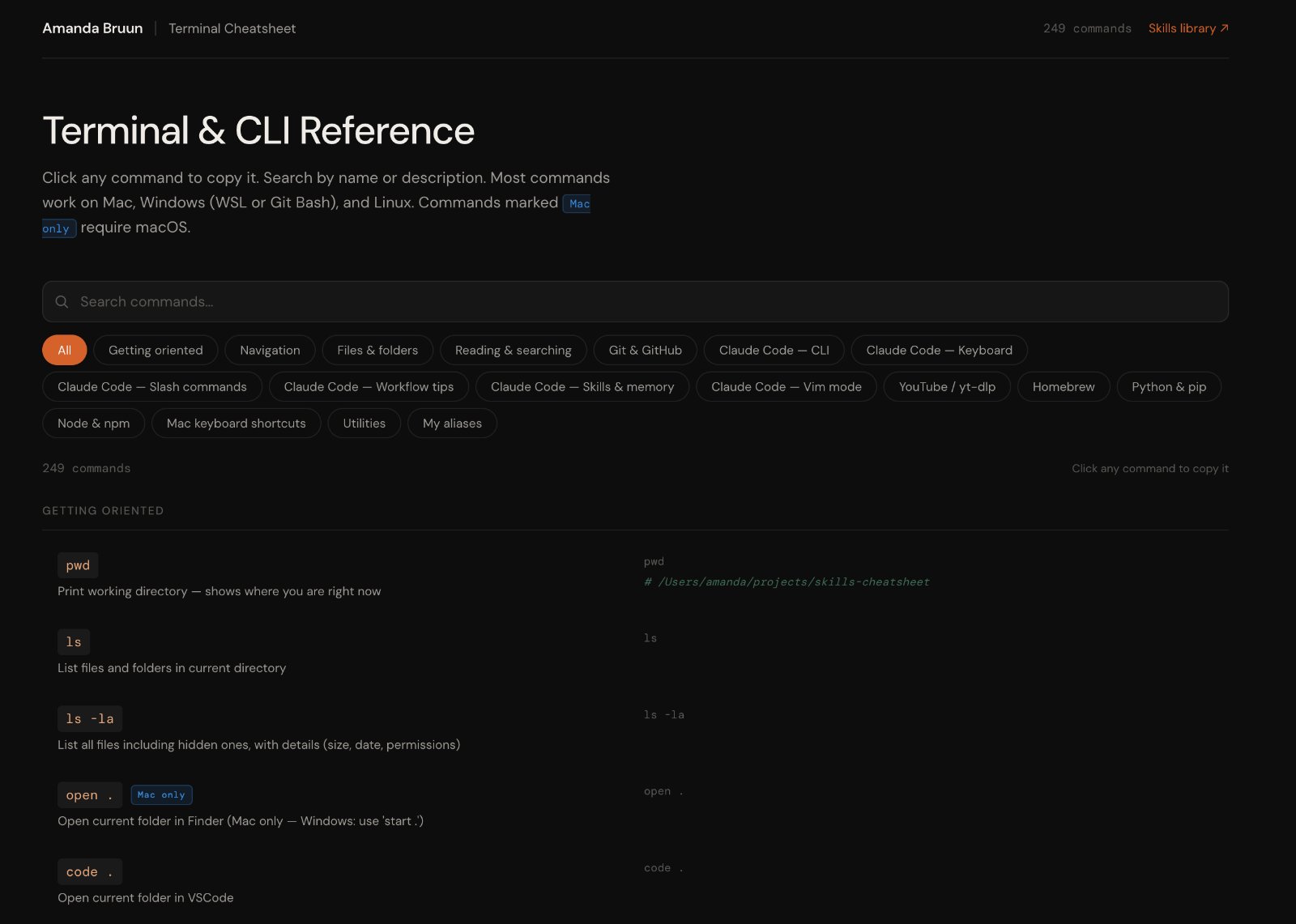
249 commands, click any to copy, with a deep Claude Code section and notes for Mac, Windows, and Linux.

What I Learned

The fastest way to learn a tool is to make its commands one click away.

What's Next

Guided paths for the most common building tasks.

dailydigest-dashboard.manus.space
Capacity ThemeAI Capacity
TypeAutomation
StatusPrivate build
Started2025
StageRunning daily

The Challenge

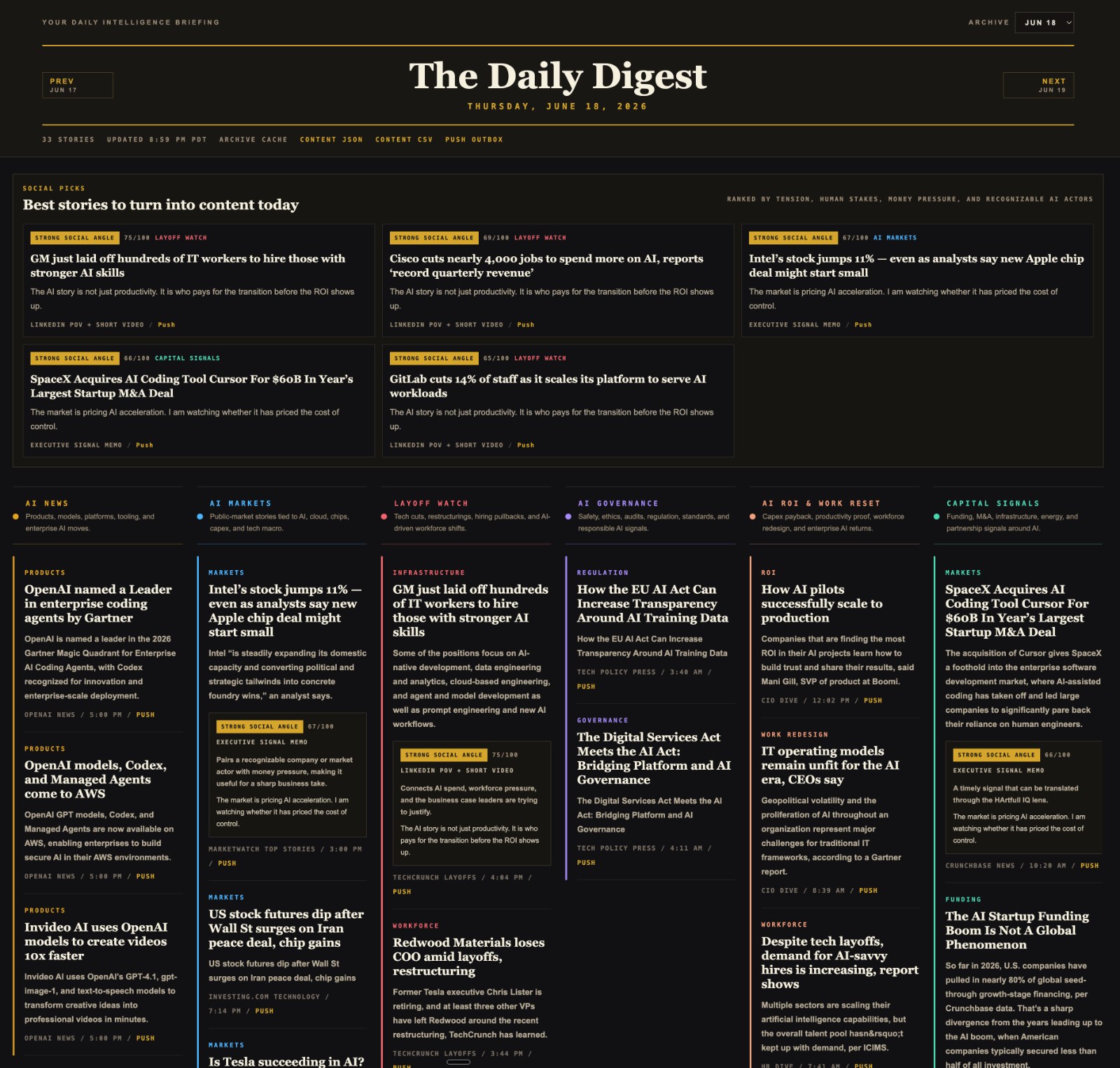
The signal that matters is scattered across too many sources to read before the day starts.

The Question

What would it take to walk into the first meeting already caught up?

My Approach

An automated dashboard, built on Manus, that compiles the day's intelligence into a single briefing.

What I Learned

Signal is worthless if it arrives after the first meeting.

What's Next

A shareable version for teams that want the same head start.

Private build — showcased, not publicly linked
04 — Capacity dimension

Emerging Experiments

Early builds and side quests — ideas tested in public before they earn a category, plus the systems that quietly run the practice itself.

Four projects
In the notebook
wheel-genius-finder.lovable.app
Capacity ThemeDecision Capacity
TypeExperiment
StatusActive
Started2025
StageShipped

The Challenge

Car shoppers arrive overwhelmed, and sales teams spend the first hour figuring out what they actually want.

The Question

Can a quiz do the qualifying so the human conversation starts further along?

My Approach

15+ questions on budget, lifestyle, and habits that return three personalized picks.

What I Learned

Qualifying before the conversation respects everyone's time.

What's Next

Adapting the pattern for other high-consideration purchases.

curated-finds-catalog.lovable.app
Capacity ThemePersonal Capacity
TypeExperiment
StatusActive
Started2025
StageShipped

The Challenge

Selling across Facebook Marketplace, Poshmark, and more scatters your inventory into places buyers never see together.

The Question

What if every listing lived in one filterable storefront?

My Approach

A single catalog that pulls everything together so buyers browse it all in one place.

What I Learned

Scattered listings lose sales. One place to browse changes the math.

What's Next

Auto-syncing listings as they change across platforms.

Capacity ThemePersonal Capacity
TypeWebsite
StatusLive
Started2025
StageMaintained

The Challenge

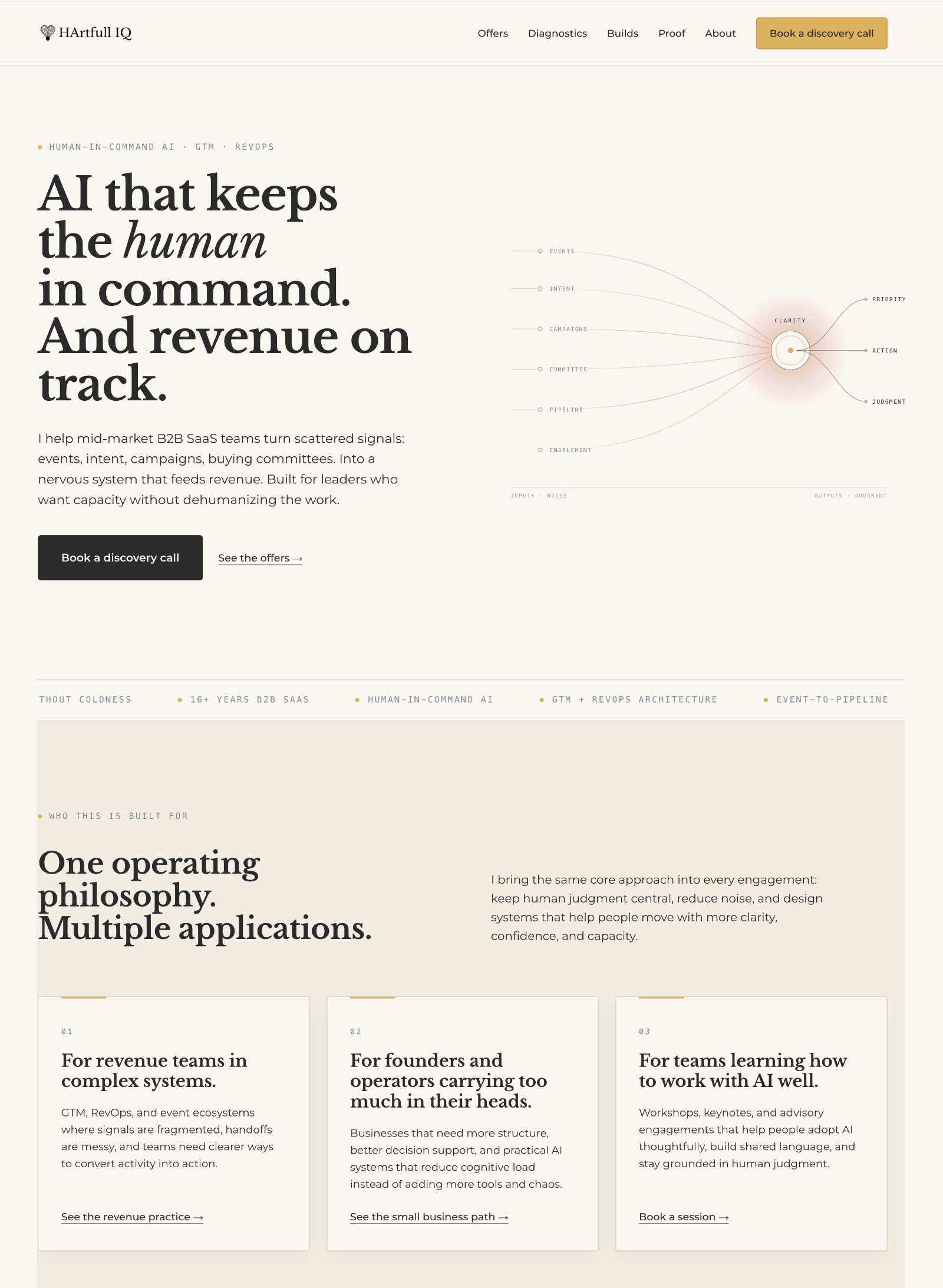
A practice about Human-in-Command AI has to look like the work — not like an agency built it.

The Question

Can I build and maintain a warm, editorial site entirely with the method I sell?

My Approach

Design and ship it myself, keep judgment in every decision, and treat the site as ongoing proof.

What I Learned

The best proof of a method is using it on your own front door.

What's Next

Growing this lab into the site's defining experience.

You're here
Capacity ThemePersonal Capacity
TypeWebsite
StatusLive
Started2025
StageMaintained

The Challenge

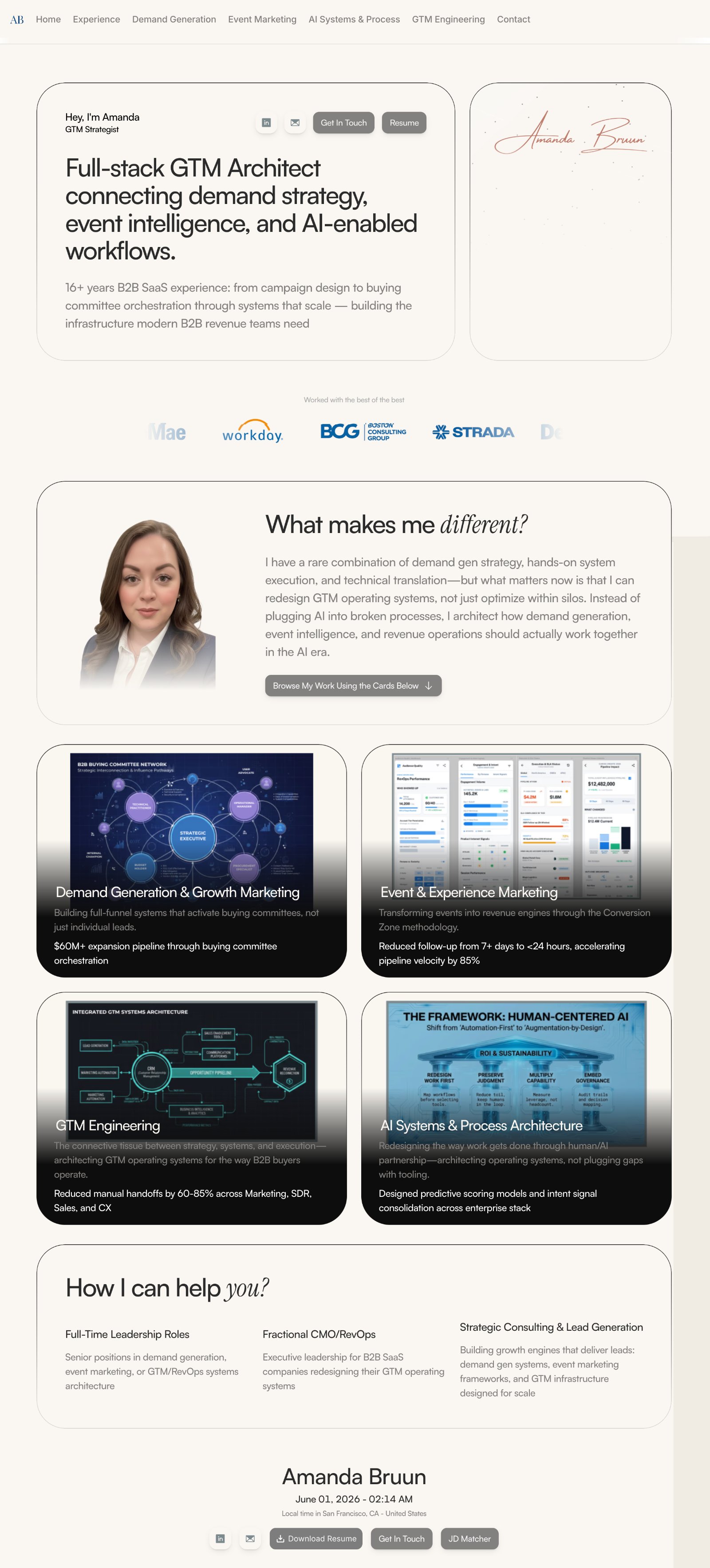
The practice needs a place to hold the operator background and the human reasons judgment stays central.

The Question

How do you keep the person visible in a field racing to remove them?

My Approach

A personal counterpart to HArtfull IQ — the fuller story, in a human voice.

What I Learned

Judgment stays central because someone's name is on it.

What's Next

Weaving the lab and the personal story closer together.

Want one built for you?

Tell me what you're trying to build.

An app, an agent, a diagnostic, a whole site. Sketch it in a sentence and I'll tell you the fastest honest path, or book a call and we'll scope it live.

Opens your email, prefilled. No form, no funnel.